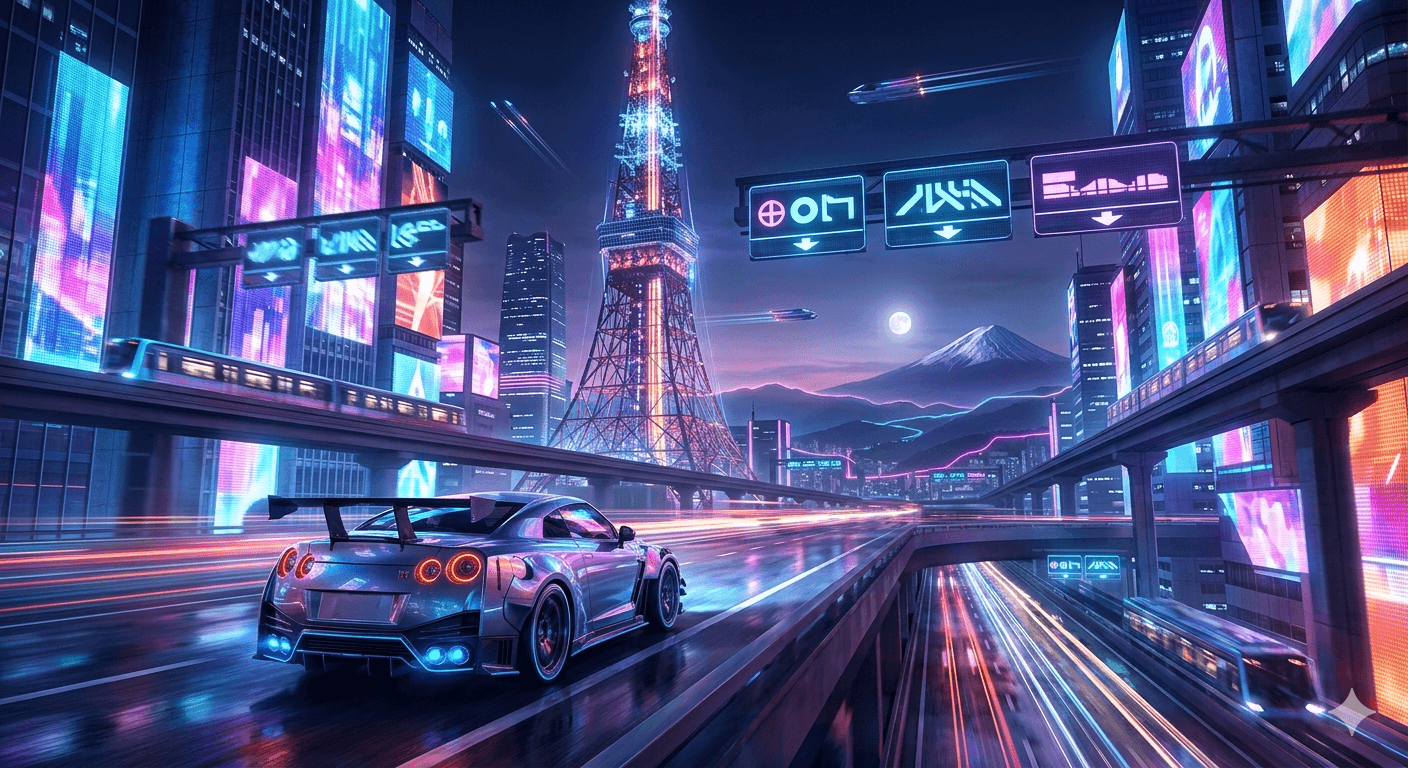
This isn't just a change of scenery; it is a critical evolution. Japan represents the spiritual heart of automotive subcultures that Horizon celebrates. From the birthplace of drifting on mountain passes (touge) to the sleek, neon-drenched urban architecture of Tokyo, the setting demands a monumental leap in visual technology, stability, and world design. In this article, we'll strip away the marketing gloss and take a technical look at how the Forza Tech engine is adapting to the challenges of 2026 hardware to create the ultimate Japanese racing experience.
1. The Biomes of Tomorrow: From Shuto to Snow
The greatest challenge facing Playground Games wasn't if they should go to Japan, but how to accurately reconstruct its overwhelming complexity. Mexico was a massive map, but it was defined by wide-open deserts, sparse jungles, and low-density towns. Japan, conversely, is characterized by dense verticality in its cities and intricate, ancient geography in its rural areas.
Forza Horizon 6 will utilize an evolution of the biome system seen in FH5, but optimized for greater object density and complex lighting. Players can expect several core visual experiences:
The Neo-Tokyo Core (Shuto Expressway & Shinjuku)
This is the showcase biome. Photogrammetry and laser-scanning technology have been deployed on an unprecedented scale to capture the precise architecture, road curvature, and even the unique texture of Japanese asphalt. The urban core isn't just a backdrop; it is a complex grid of multi-tiered expressways (like the C1 loop), tight alleyways, and massive, glass-clad skyscrapers.
The Technical Challenge: Object Draw Distance and Streaming. To prevent pop-in while driving at 250+ MPH through a canyon of complex geometry and hundreds of high-resolution textures (shop signs, vending machines, utility poles), Playground has rebuilt its asset streaming pipeline. The game now leverages the high-bandwidth I/O capabilities of 2026 NVMe drives and advanced samplers like DirectStorage 1.2 to feed the GPU on demand. This allows for massive, detailed urban vistas that remain stable even during chaotic races.
The Sacred Mountain Passes (Mt. Fuji & Hakone Touge)
The other pole of Japanese car culture. These biomes focus on organic complexity—millions of individual, photorealistic trees, detailed rock formations, and, critically, complex weather systems. The touge roads are tight, demanding a change in physics implementation (more grip modeling for tight, cambered corners) compared to the wide-open roads of previous titles.
The Rural Heart (Kyoto & Shirakawa-go)
This provides the contrast. Traditional wooden architecture, rice paddies, and moss-covered temples. The challenge here is rendering complex reflections (on water paddies and wet roofs) while maintaining performance.
2. Advanced Global Illumination: Lighting the Neon Night
Lighting is the soul of any Cyberpunk or near-future aesthetic. The decision to make Tokyo a primary location means that the Forza lighting model, previously known for mastering natural sunlight, had to master artificial luminosity.
In Forza Horizon 6, night racing is transformed by full Ray-Traced Global Illumination (RTGI) on high-end PC hardware and optimized RT Shadows on console (targeting 1440p @ 60 FPS in 'Quality' mode). This is not just ray-traced reflections (which were limited to the ForzaVista car viewing mode in FH5), but dynamic lighting where every source—a neon sign, a store window, or another car’s headlights—casts realistic, bouncing light across the rain-slicked asphalt.
A 'Wet Weather' Visual Feast: The dynamic weather system is more granular. A light evening shower won't just create puddles; it will cover the entire Shuto Expressway in a thin film of water. This dramatically changes the RT calculation, turning the urban canyon into a mirror of light trails and color. High-end PC users with 16GB+ VRAM and powerful GPUs will experience a visual fidelity previously reserved for pre-rendered cinematic benchmarks.
3. World Stability: Keeping 12 Million Poly Models from Clipping
Forza has always boasted the most detailed car models in the genre. For FH6, the "LOD 0" (Level of Detail 0, the highest quality model) polygon count for new cars has nearly doubled. To keep this visually coherent, Playground has implemented an improved physics engine.
Stability is essential when you have supercars hitting massive jumps over elevated expressways or drifting around tight concrete barriers. The updated engine handles object collision and physics-based deformation with greater stability, minimizing the jarring clipping artifacts that occur when a wheel or a bumper makes high-velocity contact with the environment. This is critical for maintaining immersion when the visual fidelity is pushing photo-realism.
4. The 4K 120Hz Challenge: Variable Refresh Rate is Mandatory
For technical enthusiasts, the goal isn't just 4K resolution; it is 4K 120Hz. In FH5, even top-tier rigs struggled to lock 4K 120Hz at maximum settings without resorting to resolution scaling.
Forza Horizon 6 utilizes DirectX 12 Ultimate and Vulkan renderers, optimized for modern multi-core CPUs. The standard console experience targets 4K @ 60 FPS for quality and a rock-solid 1440p @ 60 (potentially dynamic 4K) for performance.
Why VRR (Variable Refresh Rate) Matters: Given the massive density shift between rural biomes (low load) and Neo-Tokyo (extreme load), the game’s frame time variability is expected to increase. VRR displays (FreeSync and G-Sync) are no longer a luxury for this title; they are essential for smoothing out the micro-stutter that occurs when a high-end setup drops from 110 FPS to 90 FPS during an intense urban night race. The game features enhanced support for DLSS 3.5 (Frame Generation) and FSR 3.0, which use AI to generate intermediate frames, allowing users to achieve that high refresh rate feel even when the native rendering pipeline is heavily stressed by the RT workload.
5. Summary: A Foundation for the Future of Racing
Forza Horizon 6 in Japan is more than just a scenic upgrade. It is a necessary technological challenge that forces the Forza Tech engine to evolve beyond its comfort zone of open natural landscapes.
By conquering the complexity of dense urban photogrammetry, mastering advanced global illumination for neon nights, and stabilizing physics in a high-density world, Playground Games is laying the groundwork for the next generation of racing simulation. For blog readers who prize both stability and high-end visual performance, FH6 promises to be the definitive benchmark for 2026 hardware. Prepare to tune, drift, and see the future.